
Why stablecoins beat traditional wires
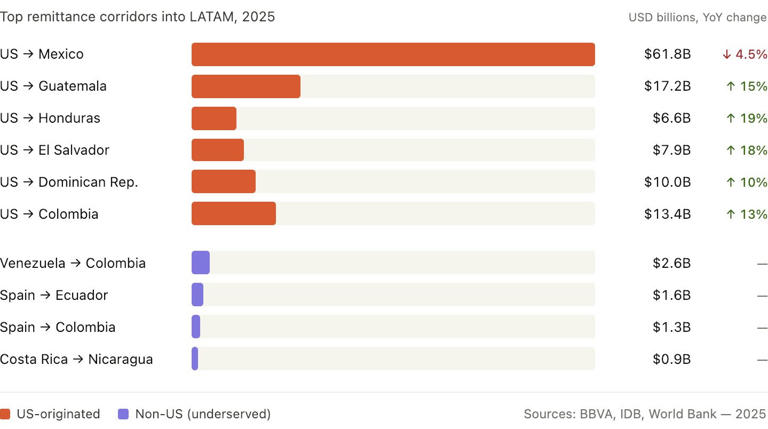
The economics of sending money home are shifting. For years, families in Latin America have accepted high fees from traditional remittance channels. According to data from Lumx, 30% of U.S.-Mexico remittances already used stablecoins in 2024, cutting transaction costs from 6% to under 1%.
This adoption is accelerating due to new financial pressures. A new remittance tax in the United States takes effect in January 2026, pushing migrants to seek cheaper alternatives. Stablecoin remittance services offer a way to bypass these rising costs and the complex banking infrastructure that drives them.
Banks in the region are also recognizing the efficiency of blockchain rails. Polygon reports that LATAM banks are cutting cross-border payment costs by 30–50% using stablecoin infrastructure. This shift is not just about lower fees; it is about speed and transparency in a corridor that moves billions annually.
Top platforms for sending USDT to LATAM
Sending USDT to LATAM requires more than just a crypto wallet; it demands a bridge to local bank accounts and cash pickup locations. The best services in this market are those that have integrated directly with regional payment rails, allowing users to convert digital dollars into local currency without leaving the app. This integration is what turns a speculative asset into a practical remittance tool.
Bitso
Bitso operates as a regulated exchange in Mexico, Colombia, and Argentina, making it a primary choice for users who need to move USDT into MXN, COP, or ARS. The platform offers a clean interface for buying and selling stablecoins with local fiat, supporting direct bank transfers and local debit cards. Because Bitso is licensed by local financial authorities, it provides a layer of regulatory clarity that many offshore exchanges lack. Users can deposit USDT and withdraw pesos or colones directly to their bank accounts, often with lower fees than traditional wire services.
Binance P2P
Binance P2P (Peer-to-Peer) connects buyers and sellers directly, allowing users to purchase USDT or sell it for local fiat using a wide variety of payment methods. This model is particularly effective in LATAM because it supports local bank transfers, OXXO (Mexico), and other regional payment networks. The platform’s escrow system protects both parties during the transaction. While Binance is a global exchange, its P2P marketplace is heavily utilized in LATAM for its liquidity and the sheer number of local payment options available to convert USDT into cash or bank deposits.
Yellow Card
Yellow Card focuses specifically on the African and Latin American markets, offering a streamlined experience for buying and selling crypto. In LATAM, it facilitates the purchase of USDT with local fiat currencies, often partnering with local payment processors to ensure smooth on-ramps. The platform is designed for simplicity, making it accessible to users who may not be familiar with complex trading interfaces. Yellow Card’s focus on compliance and local partnerships makes it a reliable option for those prioritizing ease of use and regulatory adherence over the lowest possible trading fees.
Mercado Bitcoin
As one of the oldest and most established exchanges in Brazil, Mercado Bitcoin provides a trusted environment for converting USDT to Brazilian Reais (BRL). The platform supports PIX, Brazil’s instant payment system, which allows for near-instant settlement of fiat withdrawals. For users in Brazil, this speed and the platform’s long-standing reputation make it a top choice. Mercado Bitcoin also offers a mobile app that simplifies the process of managing crypto assets and fiat balances, catering to both novice and experienced users.
Choosing the Right Service
The best platform for sending USDT to LATAM depends on your specific location and how you plan to access the funds. If you need instant access to local bank accounts, platforms like Bitso and Mercado Bitcoin are strong choices due to their integration with local payment systems like PIX and SPEI. For users who prefer cash or flexible payment methods, Binance P2P offers the widest variety of options. Always verify that the platform supports your specific local fiat currency and preferred withdrawal method before transferring significant amounts.


As an Amazon Associate, we may earn from qualifying purchases.
Stablecoin fees and settlement speeds
When sending money to LATAM, the choice between USDC and USDT, and the network you use, dictates both the cost and how fast the funds arrive. While traditional wire transfers can take days and charge high fees, stablecoin remittances typically cost below 1% and settle in minutes. This speed and low cost make them ideal for families relying on regular support.
The trade-off usually comes down to network choice. Polygon offers near-zero fees and fast settlement, making it the most economical option for smaller transfers. Tron (TRC-20) is widely supported by major exchanges and wallets, offering a balance of speed and accessibility, though fees are slightly higher than Polygon. USDC is generally preferred for its regulatory clarity, while USDT dominates in volume and liquidity across LATAM markets.
The table below compares the top stablecoin remittance platforms available in 2026, focusing on their fee structures and settlement times.
| Platform | Stablecoin | Network | Avg. Fee | Settlement |
|---|---|---|---|---|
| Wise | USDC | Polygon | 0.5% | < 1 min |
| Binance Pay | USDT | TRC-20 | 0.1% | < 1 min |
| PayPal | USDC | Polygon | 1.0% | 1-5 min |
| Circle Pay | USDC | Polygon | 0.4% | < 1 min |
Safety tips for crypto remittances
Sending stablecoins to family in LATAM is like handing cash through a glass window. You can see the value, but the risk of interception or error is real. Unlike traditional banks, blockchain transactions are irreversible. If you send USDC to the wrong wallet address, there is no customer service line to call. The World Economic Forum notes that local stablecoin infrastructure is growing, but the onus remains on the sender to ensure the transfer lands safely. This guide breaks down the concrete steps to protect your money.
Never copy-paste a wallet address without verifying the first and last four characters. Many scams involve swapping the last few digits of a legitimate address with a look-alike. If you are sending to a new recipient, send a small test amount first. Confirm they received it before sending the full remittance. This small step prevents the most common and devastating errors.
Stick to well-known exchanges and remittance providers that comply with local regulations in both the US and the recipient’s country. Platforms like Coinbase or Kraken have robust security measures and customer support. Avoid obscure, unregulated DeFi protocols for family remittances. If a platform promises returns or lacks clear identity verification (KYC) processes, it is likely unsafe. Your safety depends on the reputation of the bridge you use.
Ensure the sender and receiver are using the same blockchain network. Sending USDT on the Tron (TRC20) network to an Ethereum (ERC20) address will result in permanent loss of funds. Always confirm the network type with your recipient before initiating the transfer. This is a technical detail that causes more lost money than hacking. Double-checking the network saves you from irreversible mistakes.
Secure your own account with a hardware key or an authenticator app, not just SMS text messages. SIM swapping is a common attack vector where hackers intercept your phone number to bypass security. An authenticator app or hardware key (like YubiKey) is much harder to steal. This protects your account from being compromised while you are preparing the transfer.
Remittances can have tax implications in both the sending and receiving countries. In the US, large transfers may need to be reported. In LATAM, receiving funds may trigger tax obligations. Consult a local tax professional or use a reputable remittance service that provides clear transaction records. Keeping accurate records helps you stay compliant and avoids legal issues for your family.
Frequently asked questions about stablecoin remittances
What is stablecoin remittance?
Stablecoin remittance is the transfer of value between individuals or businesses using fiat-pegged digital tokens as the settlement asset. Unlike traditional bank wires, these transactions settle on blockchain rails, often completing in minutes rather than days, with fiat on one or both ends of the transaction.
Why are fees lower than traditional banks?
Stablecoin remittance fees are often below 1% because they bypass the correspondent banking network. Banks in LATAM are cutting cross-border payment costs by 30–50% with stablecoin rails, eliminating the overhead and markup associated with traditional international wires [src-serp-1].
What are the top stablecoins for LATAM transfers?
The most reliable options for cross-border payments are USDT (Tether), USDC (Circle), and DAI. These tokens maintain a 1:1 peg to the US dollar, providing the stability required for remittances where value preservation is critical for the recipient.
How does capital efficiency compare to banks?
Stablecoins offer superior capital efficiency because they do not require banks to hold "locked" capital to back transactions. While issuing stablecoins requires backing reserves, using existing tokens for settlement avoids the idle cash reserves that traditional correspondent banking demands, freeing up liquidity for other uses [src-serp-6].
No comments yet. Be the first to share your thoughts!